Whew! 15 months away from Dawn and the boys was a true test of endurance. When we were first informed that our twelve month deployment was lengthened to 15 months in support of the "surge", we took it in stride. But when those "extra" months came upon us, it seemed like more than 3 additional months to us. When a 4 mile run turns into 5 miles, that last mile can seem like an eternity when your lungs are burning and your legs are rubbery. Seeing the family and friends of our Soldiers on Cotrell Field at Fort Stewart was a sweet experience. Anyone who considers the sacrifices of our men and women in uniform worthy of their respect, must also consider the sacrifices made by their families. I am humbled by the sweet support of my wife, our sons--and all those who have helped care for them while I've been deployed.
(The sign Benjamin is holding in the above picture is inspired by google/gmail's chat interface that Dawn and I sometimes used to stay connected with one another during the deployment. If she were signed in, there would be a green dot next to her name. The two green dots represent our connection. As brilliant as her idea was, I was too sleep deprived and exhausted from the previous week's travel to get it right away.)I have included a few pictures here of our reunion ceremony. We marched onto the field with stripped down uniforms (all ammunition and other combat equipment had previously been removed), rendered a salute to the national flag as the national anthem was played, sang the
"Dog-Face Soldier" (3rd Infantry Division song), and the Army Song--then we were released to our families. That's when we really felt like singing. I confess, being home seems surreal; I keep waiting to wake from this sweet dream. Please continue to keep our Soldiers in your thoughts and prayers as we reintegrate with our families and society in general. Please continue to remember the families of our brothers killed-in-action: Matthew Zeimer, Kelly Youngblood, Forrest Waterbury, Adrian Lewis, Daniel Cagle, and Steve Butcher. Thank you for your tremendous support during this last deployment.
Thursday, April 03, 2008
Home at Last, Home at Last
Tuesday, March 25, 2008
Farewell Friends
Before leaving Iraq for Fort Stewart, Georgia, we paid one last visit to our dear friend Sheik Hayis (spelled "Heiss" in previous posts below). Our commander, LTC Silverman, has developed a genuine and meaningful friendship with Sheik Hayis, whose leadership has been influential--even pivotal--in the success in Al-Anbar in general, and Jazeera specifically.
His friendship with LTC Silverman has been extended to me, and in addition to introducing me to Sheik Abdullah, he was also instrumental in that relationship's development. Sheik Hayis and I exchanged gifts (see post "Cultural Exchange" 20 August below), and you will see he displays the Prayer at Valley Forge print above his grandfather clock.
In addition to discussing the province's progress and the importance of incorporating the rising generation of Iraqis into the stabilization and growth process, we enjoyed a traditional meal of lamb, chicken and fish with rice, pita bread and fresh vegetables.
As we ate, Sheik Hayis shared with us a video recording of a local group of dervishes who performed for him the previous evening. In states of religious ecstasy, these dervishes impaled themselves with swords (through their torsos, skulls, throats, etc.) burned themselves, and demonstrated other bizarre and violent skills that they believe demonstrate the limitless support God gives to those fully devoted. As fascinating as it was to watch, my appetite suffered.
It was difficult for LTC Silverman and Sheik Hayis to say farewell to one another. Sheik Hayis' place has long been associated with progress, and the members of the colonel's and sergeant major's PSDs (personal security details) were anxious to say goodbye to him and have their pictures taken with him. I am including a recent picture of many of them here.
Sunday, March 23, 2008
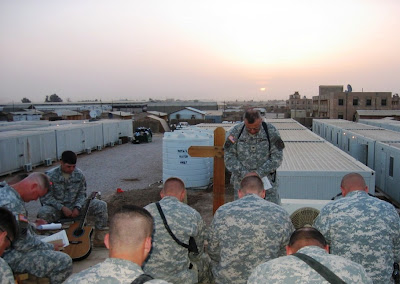
Easter Sunrise: Up Early, Up Top

With so little time before we redeploy back to Fort Stewart and reunite with our families and friends, it can be difficult to focus and appreciate the Easter event for its foundational role in
providing meaning and purpose in our lives. In an effort to reclaim this understanding, we woke early this Easter morning to celebrate Easter in a sunrise worship service. We collected what few chairs and benches remain in the area and gathered on the roof of our battalion headquarters. We were senior leaders and junior Soldiers, male and female, black and white, and represented a vast array of denominations to include those with no religious preference--only in combat do we see such unity in diversity.
We opened singing "Holy, Holy, Holy" and SGT Goudy offered the invocation. SSG Smith, SPC Willis, and CSM Johnson provided our gospel readings, and COL Rathje prayed for us and led us in the Lord's Prayer.
SPC Thomas played the guitar and SGT Dewalt led us in singing "Amazing Grace". SPC Thomas expressed concern that his rendition may have been a bit too country.
We were also joined by several civilian contractors and interpreters whose fellowship has been a blessing to us this fifteen months. 
Among the principles we discussed this morning was the renewal of life that often occurs in the desert. Whether it's ancient Israel, the Savior himself, or those deployed to combat zones in the middle east., the opportunity to set aside the clutter and clamour of the world's distractions and focus on one mission can be a blessing (as long as it's not too long, of course).
We must allow him to focus us that we may remember that God calls us into personal relationship with him; he does this through Jesus. He calls us by name. It was Jesus speaking her name, that caused Mary to recognize him. It was Jesus blessing and offering his disciples food that caused them to see him.
Even though, at first, their eyes did not identify him--they later recalled that their hearts burned as he opened to them the scriptures. Broken and sinful, we must not think we can be his disciples without fully relying on his redeeming grace. When we think such discipleship is too hard, it is usually because we are trying to do it all on our own. It's not too hard; it's impossible. And yet "with God, all things are possible" (Matt 19:26). Jesus' disciples in the first century were just as clueless and scared as we are in the twenty-first century. The hope that comes from his Resurrection overcomes our fears.
It has been an inexpressible joy to witness the spiritual maturity of many leaders and Soldiers during this deployment. Some of the darker moments of this tour were particular opportunities for growth and understanding. Just as we sometimes witness Soldiers who have become physical or psychological casualties--the threat of becoming a spiritual casualty is equally real. I thank God that so many of our Soldiers have developed a relationship with him and continue to find his peace.
Saturday, March 22, 2008
Combined Presence
Now that we have ceased combat operations and turned over our battle space to incoming units, we are gathered together here at Camp Ramadi. Over the past 15 months, we have been spread out--so the nearly 900 Soldiers of our battalion is something we haven't witnessed since before we left Fort Stewart back in the winter of 2006.
Now that everyone's returned from their respective areas of operation, it's a little over whelming to see everyone together in one place.
As companies began sending their Soldiers in, we had a battalion formation with just over half of our Soldiers present. The Commander addressed a few issues relating to the turning in of vehicles and equipment. I am including a few pictures here of that early evening formation--as the sun was descending into the dusty horizon. To be sure, every Soldier dreads formations--especially if they are long. That being said, there is still an element of pride to experiencing what it means to be a part of something much larger than yourself. Hardship, boredom, and even grief can be forgotten in the moment a unit sounds off with it's motto: ours is "Speed and Power!"

Another aspect of our imminent return is award ceremonies. Soldiers and leaders receive medals for their combat service and valorous acts. We had a good handful of young men receive the Bronze Star and Army Commendation Medals with Valor. SFC Rodriguez was awarded the Silver Star. Several received the Purple Heart and Combat Infantry and Combat Action Badges. Although it would be great to receive these medals in the company of our families and friends back home--our reintegration training and leave schedule precludes us from making the needed time.
LTC Silverman is pictured here presenting the Bronze Star to SSG Saechow and offering our battalion's OIF V coin to SSG Weston and the Soldiers of Charlie Company 2-7 Infantry, who were attached to us the entire deployment.Friday, March 21, 2008
Weathering Highs and Lows
Iraq has peculiar weather and terrain conditions. When I first arrived in Iraq in January 2005, I was surprised by how cold and rainy it was.
There seemed to be a couple of months of winter, a month of spring, and then the rest of the time was summer. It seemed this was a land of extremes. The dust storms were particularly miserable. As stated below, the sand in Iraq is not beach sand; it's not tiny pebbles, but dust from clay; it is fine, powder like flour. This dust gets everywhere! It can destroy computers and other equipment just as quickly as it can get into every nook of your sinus cavity.
We welcome the rain as it knocks down the dust and clears the air--but it sure makes it miserably muddy. I am including a few pictures of the weather here lately. Nearing the end of March--it doesn't feel like Spring--it's too hot. But just last week we experienced a memorable dust storm. The picture above is a satellite photo of Iraq. You can see the dust storm moving in on the west and the clouds on the east (right). 
Monday, March 03, 2008
Reintergration & Reunion
Over the past several weeks I have been giving classes to our Soldiers in preparation for our redeployment to Fort Stewart, Georgia and our reintegration with our families.
As mentioned in an earlier post below, the first class I provided addressed the issues of suicide awareness and sharing combat experiences. The ideal size of a group attending these classes is about 30-40 Soldiers, allowing me to customize the material and provide for exchange and conversation. Each class or brief was a little over one-hour long. Today, at JSS Hawas, I finished the last of these briefs; I have conducted 44 of them. LTC Silverman, CSM Sumner and 1SG Biggs have sometimes joined me in teaching—their occasional presence not only lends validation to the subject matter, but gives me a much needed breather.
The repetition turns my brain to mush, but the unique dynamic of each group has helped keep me focused. At the risk of sounding boastful, I must say these briefs have been an absolute success. Soldiers’ attentiveness and engagement during the conversations have less to do with my skill and presentation and more to do with their own appreciation for the challenges that lie before us upon our return home. Soldiers always stick around afterwards with individual questions or to make appointments for counsel.
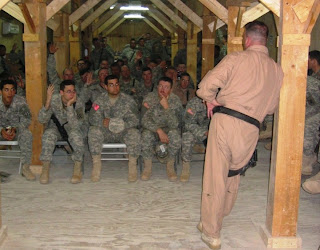
The subject matter of this second class has been divided into three sections: self-care, family-care, and the contrast between combat and garrison life. Within the realm of self-care, we discuss diet, exercise, sleep, alcohol, and finances. (The principle to remember in every case is self-discipline.) As sweet as it is to be home, Soldiers and leaders can easily become frustrated and irritated with the lack of purpose and mission they experience when compared to what they regularly experienced in combat.
One of the seven Army Values is integrity. I have explained that the root word of integrity is “integer”—yes, the same word we were introduced to in math class. Just as an integer is a whole number, such as 2, 3, or 4—and a 2 is a 2, and not a 3—having integrity is being true to who I am:
who I am as a professional, as a husband, father, son, friend, neighbor, etc. Furthermore, the goal of reintegration is to be true and loyal in my roles as husband, father, and Soldier. Reintegrating is the process of finding our groove—so to speak—in being true to the roles that help define us. It’s unimaginable that one could return from combat and reintegrate without difficulty; we will all hit a few speed bumps along the way; some of us will hit a brick wall. Recognizing that difficulties are common can help us patiently endure this season of adjustment.
Among the issues of great interest is intimacy. Soldiers—and most in our society—understand this word as a synonym for sex. It is essential we understand it to mean connection and closeness, and it is therefore helpful to acknowledge there are various forms of intimacy. It is wise for couples to acknowledge their need for sexual, emotional, intellectual, spiritual and physical intimacies. Every Soldier has changed during his tour, and so have our family members. Change is natural and, of itself, is not a threat. The long separation makes it difficult to connect as easily as we would like, or as we had previously—but patience and time will payoff.
Intimacies or connections can be re-established. Since love is what we do rather than how we feel, we should not be alarmed if the same feelings for one another do not fully and immediately return. They are nurtured in relationships of trust, security and mutual respect. In other words, how we feel for one another (which, is important, no doubt) is largely determined by how we care for or serve one another. So when a leader—because it’s been his custom for the past 15 months—speaks to his wife as if she is one of his Soldiers, she won’t like it.
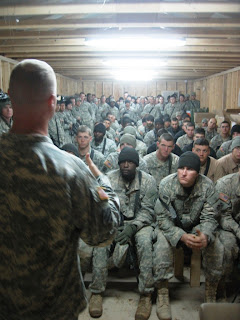
But if she can keep in mind that he likely didn’t intend disrespect, then it will be easier for her to be patient with him as he becomes reacquainted with communicating in a fashion that is personal, rather than professional, and horizontal, rather than a vertical. The same is true of the Soldier whose wife speaks to him as if he is a child. Although offensive, it is wise for him to remember that the mode of communication with which she’s been most familiar during the past 15 months is parent-child. He’s going to use his business tone with her and she’s going to use her maternal tone with him—and each will do well to be patient with the other.
Unfortunately, many of our Soldiers’ marriages have not weathered this storm. Some will return single or in the process of divorce. Others expect that it may soon be the case for them. I counsel couples not to press the issues of contention prematurely. Wait until the dust settles. Seek out any one of the various resources for counseling and marriage enrichment: unit chaplain, family life chaplains, counselors available through http://www.militaryonesource.com/ , or one’s pastor/religious leader—to name only a few.
Finally, it is essential to remember that everything of value comes with a price. The cost of a loving and stable home environment is hard work and patience. That being said, many couples report experiencing increased understanding and connection upon reunion—and what work and patience is required will (for a change) be something they can finally work on together, side-by-side. 
Thursday, February 28, 2008
Guitars for Grunts
As you all know, when we first arrived in Ramadi in January 2007, things were pretty hot--kinetically speaking. It was immediately clear to us why others had called Ramadi the most dangerous city in the world. We lost our first Soldier--PV2 Matthew Zeimer--while we were still in our right-seat-ride (first week of being shown the area by the outgoing unit), and continued to lose Soldiers somewhat regularly thereafter. Those days were particularly heavy for us. It is with humble gratitude (and I must confess, a little effort to suppress the superstition one experiences with mentioning such things while still in combat) that I acknowledge we've not lost a Soldier since 23 May 2007--the night SSG Steve Butcher and SPC Daniel Cagle were killed in action.
We often speak of our Soldiers killed in action. We regularly pray for their families. The grief counseling I provide is something that continues long after the tragic event of death. Since that time we have been contacted by these Soldiers' family and friends with reassurance that our safety and mission remain in their prayers. A few months ago, I was contacted by Paul Hickman, a former Marine who's organized a charitable organization: Guitars for Grunts. (see http://www.guitarsforgrunts.com/ ) His network of friends provides guitars to troops serving in Iraq and Afghanistan.
Paul coordinated with Frank De Gennaro to send us a guitar in memory of SPC Daniel Gagle--a Fender Stratacoustic (electric). LTC Silverman, CSM Sumner and I recently visited our Alpha Company Soldiers down at Joint Security Site Sedgwick, and presented the guitar to SPC Cagle's fellow Soldiers.
Pictured here is me presenting the guitar to SFC Kelly, Daniel and Steve's platoon sergeant. SPC Dunkle took a few minutes to tune the guitar, and then played for the Soldiers assembled in the mess hall an arrangement of songs including Johnny Cash's well-loved ballad, "A Boy Named Sue". It was a memorable event. It struck me as poignant that of the various ways we express our grief and remember the fallen, expressions of creativity and art are perhaps the most therapeutic. I wish to thank the folks at Guitars for Grunts and every other organization, group, or individual who has supported us during our deployment. Your gifts help keep us from becoming calloused.
Monday, February 11, 2008
The Crew
Over the past several months SGT Tremain and I have facilitated our ministry to Soldiers by joining our Command Sergeant Major in his battlefield circulation. We're usually on the road Mondays through Saturdays. SGT Tremain and I have come to know the crew members on our respective trucks quite well. It's not uncommon for us to be on the road traveling for four hours a day. Not even the ever present threat of IEDs (roadside bombs) is enough to keep these trips through the bland desert from becoming boring.
Our crew consists of the sergeant major; he commands the vehicle. SPC Crerend is our driver and radio operator. PFC Testa is our gunner, and I am the passenger. (During my previous deployment I drove thousands of miles. Now that trucks have turrets and .50 caliber machine guns mounted to them, driving them is viewed as a violation of my strict role as a non-combatant.) Each morning we begin our trip listening over our headsets to the sergeant major reading the daily intelligence summary of threats in the battle space. Each of us wears a Bose headset that allows us to speak to one another within the truck, with the other two gun trucks, and with companies' and higher headquarters.
Some of our more interesting conversations of late have concerned NASCAR (I am learning more than I ever wanted to know from the sergeant major), foods and restaurants we're looking forward to when we return to the States, and our favorite TV shows growing up. Because CSM Sumner and I are in our late thirties and SPC Crerend and PFC Testa are in their early twenties, many of our conversations are made even more interesting with the generation gap.
Thursday, February 07, 2008
Specialized Ministry
During my battlefield circulation, I visit the Latter-day Saint members of our battalion. As occasion permits, we conduct brief, field worship services, in which we bless and partake of the Sacrament: the LDS equivalent of Communion or the Lord's Supper. It is a simple ceremony, but its familiarity and meaning provide us with a profound sense of peace. Of course, our services seem woefully incomplete without the beautiful distractions common to the worship experience with our families back home: holding my wife's hand, cheerios between the folds of the pew cushions and wrestling with the children to pay attention are a few of my favorites.
The group photo above is of the of Latter-day Saint Soldiers, Sailors, and Marines who worship on Sunday evenings at Camp Ramadi. I visit SSG Risperess (pictured here in his maintenance trailer) and SPC Robinson at JSS Zeimer. SFC Stock and 1LT Denning are pictured below on the occasion of our setting apart Brother Denning as an assistant group leader.
PFC Dinkel is the medic for the platoon that has moved from Hurricane Point to Cop Charlie, and recently to COP Bravo. The picture here was taken of us in his aid station, where we had our sacrament meetings. The final picture is of COL Rod Allen at the Government Center. He and I met at Camp Blue Diamond and got to know one another quite well. He's since redeployed, and is back home with his family in California. 
Friday, January 25, 2008
Changing of Commands
Of the highlights in an officer's career, among the most cherished is his time as a company commander. This is generally an 18-24 month period, after 5-8 years of service.
The size of a company ranges from about 70 (the size of a typical tank company) to more than 200 (the approximate size of our forward support company, which includes mechanics, fuelers, cooks, etc.). A commander is especially fortunate if he has the opportunity of commanding his company in combat. A young lieutenant--fresh out of college and his officer basic course--looks forward to getting to his first unit and the sudden and serious responsibility of being a platoon leader.
As a platoon leader, he often looks up to his first company commander and sees him as a mentor. He watches his commander very closely. He knows if he performs well, in the coming years he will have the same opportunity. Company commanders function under a great deal of pressure. The expectations of their battalion and brigade commanders, as well as those from his own Soldiers and NCOs, is a burden without parallel in the civilian world. Most of our company commanders are about 30 years old.
During our deployment, all but two of the eight companies in our battalion (or attached to our battalion) have experienced a "Change of Command". After his time in command, the outgoing company commander steps aside and a new, bright-eyed captain steps into his big shoes. One of the more transparent but critical aspects to this change of command process is the stability the company experiences from the leadership of the company's senior Non-Commissioned officer: the First Sergeant.
It is his responsibility to plan, rehearse, and execute the Change of Command Ceremony. The ceremony is rich in tradition. In our battalion we sing our Division Song, "The Dog-Faced Soldier" and the "Army Song". The company guidon is a small flag that identifies the company and serves as a symbol of the commander's authority and responsibility. The outgoing commander passes it to the battalion commander, who passes it to the incoming commander, who then returns it to the First Sergeant.
The ceremony gives the outgoing commander and his battalion commander an opportunity to speak to the company's Soldiers in formation. In addition to senior, military leaders our special guests sometimes include local leaders such as the tribal sheikhs pictured here. Tuesday, January 22, 2008
Re-deployment Training at Zeimer
Although it's still a ways off, our redeployment to the States requires a good deal of preparation.
As others will soon be accounting for equipment, vehicles, etc., my role in this preparation includes conducting briefings for all of our Soldiers. Over the next three weeks, the topics I will cover range from the sober--suicide prevention and awareness--to the humorous--highlights and lowlights of Soldiers' combat experiences. Quality demands that these briefs and discussions take place in small group settings--ideally, one platoon at-a-time. As spread out as our Soldiers are, this will take a while. After these topics are covered, it will take another few weeks to address the even more delicate issues related to reunion with family and life back home. 
There are several reasons why those who have experienced combat choose not to discuss it with their loved ones back home. Most often, Soldiers explain that others will not be able to relate. Some explain that they're uncertain how others would react, and don't want to be judged. Quite a few acknowledge that some of what they've experienced they wish they could forget--so why would they talk about it with spouses, parents, or friends? My approach is to explain that it is always going to be easiest to discuss these events amongst ourselves.
A single name of a place or a person conjures countless mental images and emotional responses--much can be communicated, though little is said. However, this is a cop out. Bonding with others always requires effort. Everything of great value comes at great effort. Our family and friends are worth the effort it takes to share. It takes effort to give the back story; it takes patience--both to find the words and to listen. Monday, January 21, 2008
Bravo's Bridge Operation
A while back, the enemy destroyed a bridge used to cross a river in our area of operations.
Then, before any efforts to repair it, they blew it up again, and again--never quite satisfied with their efforts. More recently our engineers have constructed a new bridge just upriver. Our Soldiers in Bravo company share the responsibility of guarding the bridge and the area in the vicinity. Each week a different group of Soldiers goes up to the bridge and takes shifts in the over watch towers. Iraqi Army soldiers are there too. They inspect the vehicles crossing. In the picture up top, a convoy of Iraqi Army gun trucks roll across the bridge.
SGT Tremain and I visited with SSG Knudsen and his squad, while CSM Sumner met with their platoon sergeant, SFC Rodriguez. (Pictured next to me here at the top of one tower is SGT "Q".)
I took the opportunity to take a few pictures of our Soldiers keeping warm next to a fire, and a few who were snug in their beds. For the week they are up at the bridge, these guys are away from what few comforts Hawas provides: electricity, heat, Internet, phones and occasional showers. Friday, January 18, 2008
Return to Ramadi
We are at a different area of Camp Ramadi than we were when we first arrived here about a year ago. Camp Ramadi is much larger than Camp Blue Diamond. Based on my runs for exercise, I suspect it is about 5 miles in diameter. Its roads are not paved. And now that it's rainy season--the fine powder clay/dust makes for a magically and troublesome glue-like clay. The mud is terrible.
I am including pictures here of our battalion headquarters: an Alamo-type quad. My office/living quarters is the first door on the left at the entrance.
SGT Tremain lives in the back-half of the room in which we store our religious supplies--right next door. We have heat (It's below freezing at night now. We had snow last week!), electricity, and limited Internet. Although significantly less comfortable than our facilities at Camp Blue Diamond, we're still happy. We live more comfortably than many of the Soldiers we go out to visit every day. Our happiness has less to do with this, however, and more to do with the realization that we are on the downward slope of this deployment; we can see the light at the end of the tunnel.
After a busy day of travel out to the combat outposts during the day, we return for exercise, dinner, meetings, counselings--sometimes a bible study, and we'll get together with the guys to watch a movie or an episode of some television show on DVD. Helicopters fly overhead on a regular basis, and there are occasional knocks on the door with personal or family emergencies--but most nights I get a decent night's sleep--something I never take for granted.
Sunday, January 13, 2008
Leaving Camp Blue Diamond
These past couple of weeks have been especially busy for me. First, we have packed up and closed down operations at Camp Blue Diamond and returned to Camp Ramadi: where we spent the first two-and-half months of this deployment. Moving from place to place is common in the military; it is especially the case in combat. Closing down Camp Blue Diamond meant saying goodbye to creature comforts and the coziness that comes from knowing I was the chaplain for everyone I saw throughout each day: Soldier, Sailor, Marine, or contractor. Closing down Blue Diamond is also an indication of the success we've been experiencing this year.
Another exciting event was the visit of my dear friend and fellow chaplain, Tim Fary. His battalion is attached to a Marine regiment, so I haven't seen him much this year. Some of his Soldiers are attached to our battalion, so he thought he would come check on them and if that meant we could spend a few days together, that would be fine too. A real test of his friendship is that his opportunity to travel required him to fly when his team--the Tennessee Volunteers--were busy schooling the Wisconsin Badgers in the Outback Bowl. We had a friendly wager on the game. I lost and am busy learning the words to "Rocky Top".
Our last worship service at Camp Blue Diamond was memorable. We have spent the last ten months getting to know one another, and our returning to Camp Ramadi meant an end to our small worship community. After the service, my friend and brother, Marine Colonel William Dwiggins, presented me with a framed certificate of appreciation and flag that was flown over his team's headquarters on Christmas Day.
The most memorable event of the trip was the emergency landing we made when the Black Hawk experienced serious problems with the rear rotor. There were three fire trucks and an emergency vehicle waiting for us when we landed. Although we knew something wasn't quite right, it wasn't until we landed and witnessed the crew's sense of relief that we realized it was a close call. I presume that many--if not most--close calls in combat go unnoticed. Friday, December 28, 2007
Santa's Super Sleigh
Early Christmas morning SGT Tremain and I enlisted the help of SPC Fuentes and PFC Hall to help load care packages we had in my office into the back of a trailer to take with us and distribute to Soldiers.
We have received more than a hundred care packages (mostly from strangers) full of tastey treats and creature comforts. We left early Christmas morning as the sun was rising. Our first stop was JSS Sedgwick and the Soldiers of Alpha Company. Their mood was light and festive. The officers had all donned holiday hats and accessories, and sang Felice' Navidad and the Twelve Days of Christmas.
Our travels from Sedgwick to Hawas took us through Falujah.
(I snapped a picture of a mosque through the window in our gun truck.) At Hawas a Marine Major told me he had three times celebrated the Holidays in combat, and the day's
Holiday Service was the best he'd ever attended. "Anytime a Christmas story involves a Harley Davidson Sportster--I'm game." 

Our last stop was JSS Zeimer, were they had set up for us in the tent-shelter maintenance bay. We made it back to Camp Blue Diamond in time to enjoy some of the leftovers from the Christmas Dinner served earlier in the day. We ate together with the Commander and Sergeant Major and members of their PSD.
Afterwards, we made it back down to the chapel/mayor's cell where all our neighbors were waiting on us to open the gifts we had exchanged with one another.
Captain Jonas Anazagasty gave me three books that have been informative in his intellectual development. I gave Sergeant Wheeler the ESPN Encyclopedia of College Football--he seems committed to reading it from cover to cover, one-page-at-a-time. (It's an Oklahoma thing. Where college football predates statehood.)
Tuesday, December 25, 2007
Candlelight Christmas
All day on the 24th and 25th our Commander, Sergeant Major, and I traveled with their personal security detail to each of the combat outposts in our area of operations.
During our visit with Soldiers we held a Holiday Service at each location. The services were traditional and included carols, readings, and a meditation--we concluded by lighting candles and singing Silent Night. The Sergeant Major and Commander participated in each of the services, with LTC Silverman sharing the story of the Christmas Eve cease-fire of 1914 between the Germans and the British. At our last stop on Christmas, one of our Sergeants offered that the service finally helped him "get into the Christmas Spirit".
We left Fort Stewart about a year ago with the expectation that the term would be twelve months, as it was our previous deployment for all of 2005. When we learned the 12 months had been extended to 15, most everyone took the news in stride--we are Soldiers after all. However, I expected by the time we got to the Holidays--a point by which we would otherwise have been packing and getting ready to re-deploy--the grumbling and complaining would become more widespread.
That hasn't happened. I'm impressed by our Soldiers' steadiness. Don't get me wrong--there's not a single one of us who wouldn't rather be back with our families. But they seem to realize that not only will complaining not help, but that the busier they stay, the quicker time goes by. Some guys have access to web cams and tuned into watch their children open presents. Others settled for a phone call or an email.
In my meditations at these Holiday Services we discussed the qualities of Joseph and Mary--their devotion to God, to their family, and to the law of the land. We considered how the example of a young, teen-aged, Jewish girl two-thousand years ago could inform the behavior and choices of American Soldiers in combat today. We thought about the necessary humility of Joseph, how he must have swallowed his pride to allow his bride to give birth in a stable or cave where animals lived.
Above all, we considered the irony not only that the Creator of this Universe would become man, and that he would do so for the ultimate purpose of overcoming sin and death--but that it would happen in what was likely a dung-scented, flea-infested cave for livestock. His birth in such a place illustrates that he is, indeed, Immanuel--God with us.
Saturday, December 22, 2007
USO Tour
To support the morale of those serving in combat zones, the USO organizes celebrity shows. We don't get them very often "out in our neck of the woods", but when we do the Soldiers and Marines seem to enjoy them.
(See the post on Chuck Norris below.) This past week Sergeant Tremain and a few of our Soldiers traveled over to Camp Ramadi to see Miss USA, Lewis Black (comedian), Lance Armstrong, Robin Williams, and Kid Rock. Soldiers get tired of hearing celebrities tell them that they are their heroes. It's not because they question their sincerity--it's just they don't believe they are heroes.
They are much more interested in hearing Lance Armstrong talk about overcoming cancer and winning the Tour de France, laugh at Robin Williams, or hear Kid Rock perform. Their favorites were Robin Williams and Kid Rock.
The celebrities always seem different to them when they're live, and in person. The guys will comment, "She's prettier than her picture." Or, "I thought he would be taller." Some of our Soldiers invited their guests to sign the gun tube of their tank. 
Tuesday, December 18, 2007
On Location: Re-enlisting Soldiers
When a Soldier chooses to re-enlist, the unwritten rule is he can choose the location of the re-enlistment ceremony.
This is within reason, of course. Often this prerogative is not exercised. Of late, we've witnessed a few ceremonies where the location adds some novelty. As mentioned in a previous post below, the decision to extend one's contract is no light matter for a Soldier and his family. It often includes a choice of duty station or military school opportunity and a bonus--which, if a Soldier re-enlists in theater, is tax-free.
Sergeant First Class Smith is our Battalion Re-enlistment NCO. He works with the Army to help Soldiers get the best options for their respective specialties. Sometimes he goes out with us to visit Soldiers, and every once in while, to conduct a ceremony.
A few of the ceremonies we've witnessed lately include four Alpha Company Soldiers who re-enlisted on the beach of Lake Habaniya, just outside JSS Sedgwick (pictured above). They asked their commander, Captain Ralls to re-enlist them. Their platoon and a few others were their to support them.
Captain Chris Haun re-enlisted some of his Soldiers at Hurricane Point recently. We walked out to the steps that descend into the Eurphates River. The previous week, Lieutenant McKinney re-enlisted a Soldier and NCO in his platoon.
This week SGT Dutan of our Fox Company, asked me to administer to him the re-enlistment oath; it was only my third time doing so. We held the ceremony outside the chapel.
The oath follows: "I (name) do solemnly swear (or affirm) that I will support and defend the Constitution of the United States against all enemies, foreign and domestic; that I will bear true faith and allegiance to the same; and that I will obey the orders of the President of the United States and the orders of the officers appointed over me, according to regulations and the Uniform Code of Military Justice. So help me God." (Title 10, US Code; Act of 5 May 1960 replacing the wording first adopted in 1789, with amendment effective 5 October 1962).
Sunday, December 16, 2007
Hurricane Point

In addition to the "Gov" Center, our Delta Company Soldiers man Joint Security Site (JSS) Hurricane Point--just across the river from us on the outside of the city. Captain Haun visits regularly, but First Lieutenant McKinney, from West Virginia, is the platoon leader and Officer in Charge. Just as he vigilantly keeps his Soldiers stocked with a variety of food and other creature comforts at Ramadi and the "Gov" Center, First Sergeant Colon ensures the guys at Hurricane Point are equally cared for.
Here the Soldiers live in a long corridor that has been sectioned off into small, individual rooms that remind me of stables. At the end of the corridor is their mess hall and CP (where the radios and cameras are monitored).
We hold worship services in the mess hall. On the other end of the building is a larger bay where the gym equipment, TV, and computers with internet are located. 
Although these Soldiers are part of Delta Company, or the Dark Knights, for much of the deployment they have been attached to various Marine Battalions--perpetual step-children, if you will. This has also resulted in the platoon becoming unusually tight-knit. Often, when we visit, they grill meat and invite us to eat with them--just one of the creature comforts made possible by their first sergeant's attentive support.